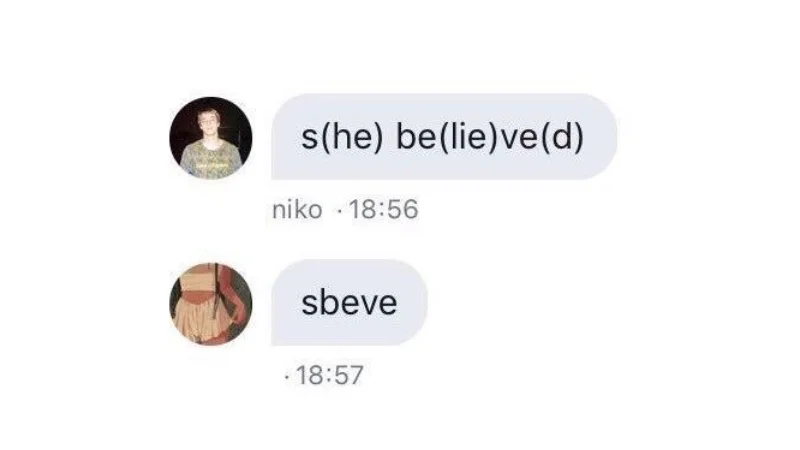
She Believed Sbeve is a catchphrase built from the mid-2000s emo quote 's(he) be(lie)ve(d),' which uses brackets to hide 'he lied' inside 'she believed'[1]. The joke went viral again in 2018 and 2019 when users mocked the format by pointing out it also spells the nonsense word 'sbeve'[2].
Origin
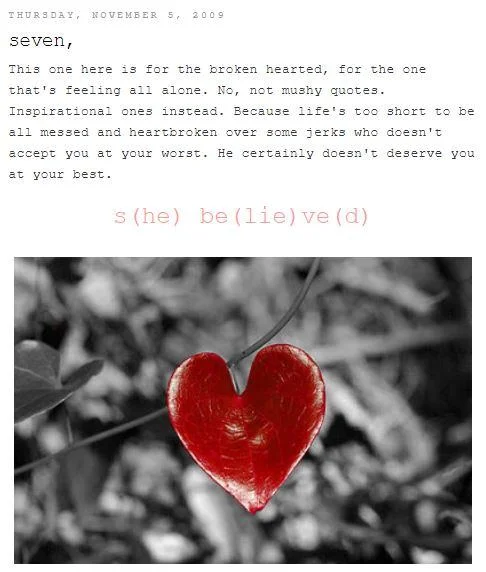
The earliest known appearance of the bracketed phrase was posted on November 15th, 2008, in a comment thread on the dating blog EvanMarcKatz.com, where a commenter named Rach wrote 's(he) be(lie)ve(d)' using parentheses to isolate the words 'he lied'[1]. A year later, on November 5th, 2009, Blogspot writer Eloquenthearts included the same construction in a poetic post about heartbreak and letting go[4].
On January 1st, 2010, Urban Dictionary user nonbiased1234 added a definition for 's[he] be[lie]ve[d]' that formalized the double reading, describing it as a stereotype of a woman naively believing a lying man[1]. The 's[he's] br[ok]en' variant was defined by user mydria on March 18th, 2011[1].
- Platform: Blog comment (origin) / Twitter and Reddit (viral spread)
- Creator: Unknown (commenter 'Rach')
- Date: 2008
Overview
She Believed Sbeve is a wordplay catchphrase written as 's(he) be(lie)ve(d),' where brackets or parentheses highlight the letters spelling 'he lied' inside the words 'she believed'[1]. The gag treats the phrase as a doubled confession, readable at the same time as an innocent statement and a bitter one. A companion version, 's(he's) br(ok)en,' works the same trick to hide 'he's ok' inside 'she's broken'[2].
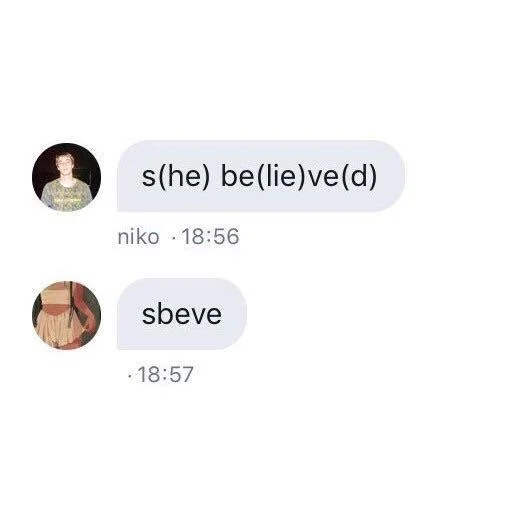
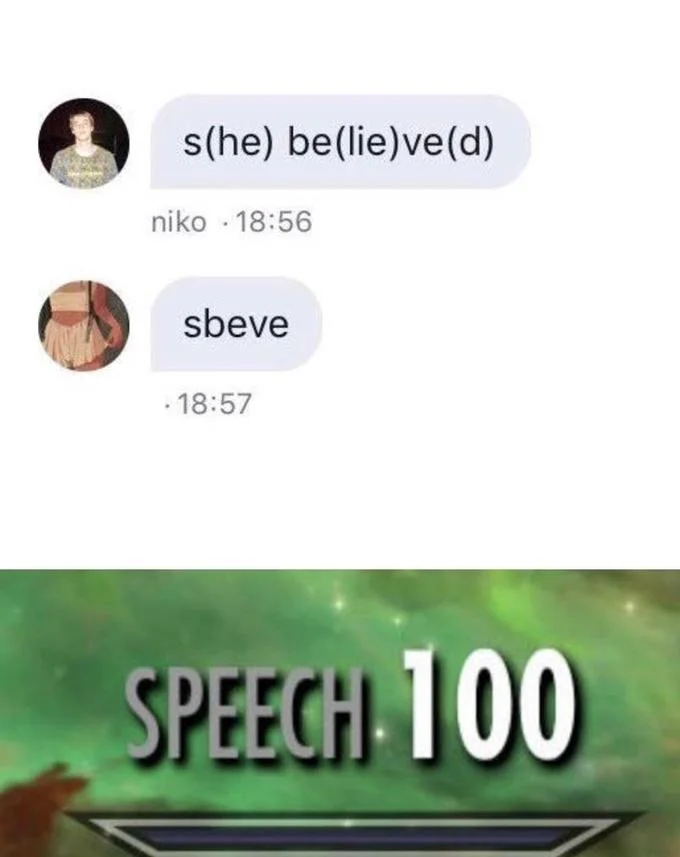
The format is a time capsule of late-2000s MySpace and Blogspot heartbreak posting, where teens shared quotes about broken hearts set against sad graphics[2]. It came back into circulation a decade later, when the same format got reread as accidentally funny because the highlighted letters, said out loud, sound like the nonsense word 'sbeve'[3]. The bracketed 'sbren' version of s(he's) br(ok)en received similar treatment[1].
How It Spread
The bracketed quote drifted through emo and quote-account culture for years before a April 28th, 2015 tweet from Twitter user @Miguelixto_ paired it with the parenthetical 'sbeve,' calling out the awkward nonsense syllable hidden in the wordplay[1]. That post did not go viral until a screenshot resurfaced on the /r/me_irl subreddit and Twitter in April 2019, pulling in more than 480 retweets and 1,100 likes within a day[1].
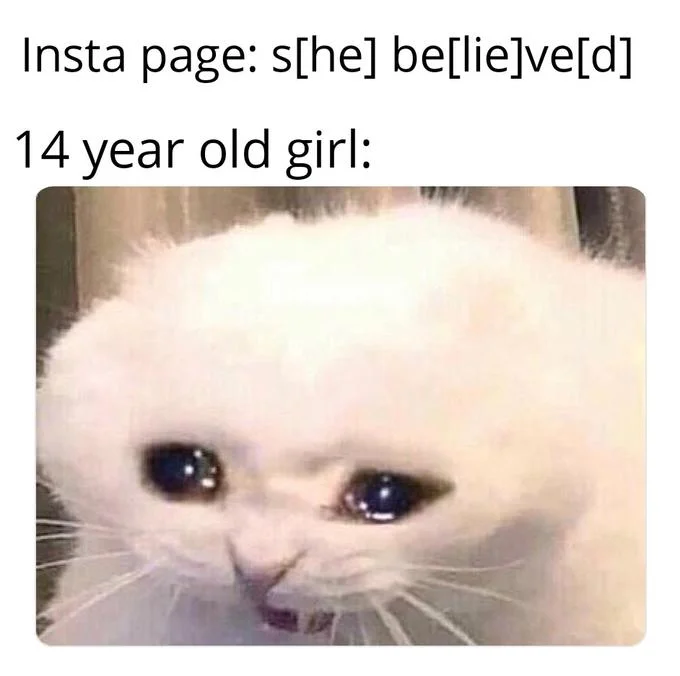
Before that revival, on February 10th, 2018, Twitter user @Scarlet4UrMa posted 'some relatable quote account in 2009: s(he) be(lie)ve(d) my 13 yr old ass:' with a reaction GIF, gaining over 89,000 retweets and 229,000 likes[1]. Redditor ohsopoor shared the screenshot to /r/im14andthisisdeep on February 18th, 2018, where the top comment was simply 'sbeve'[1]. Daily Dot pointed to this thread as the moment when the joke shifted from earnest quote to ironic mockery of 2000s teen posting[3].
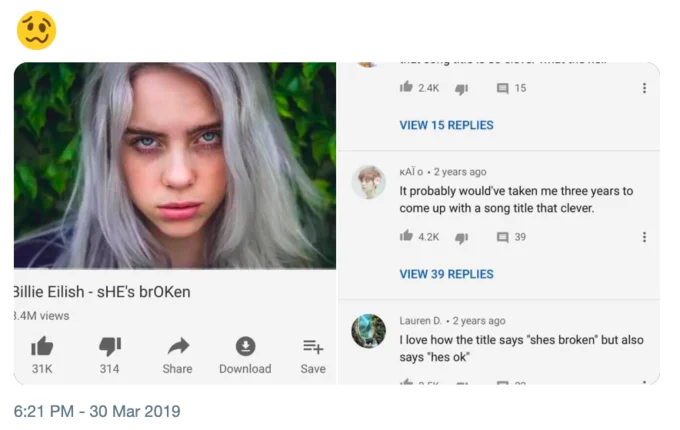
The format spiked again in early 2019 across Reddit, Twitter, and TikTok. TikToker @cassiekelly_ posted a January 30th, 2019 clip highlighting 'he's ok cause he always lied' inside 'She's broken because she always believed,' set to a remixed Alex & Sierra track that eventually appeared on over 246,000 videos[1]. On March 30th, 2019, Twitter user @neverhadit99 shared YouTube comments marveling at Billie Eilish's SoundCloud track titled 'sHE's brOKen,' pulling more than 11,000 retweets and 62,000 likes and driving another wave of reaction posts[1]. Mashable framed the revival as Gen Z laughing at the earnest brand of heartbroken graphics their older siblings once posted on MySpace[2].
How to Use
The template is typically written as a short emotional sentence with brackets, parentheses, or capitalization used to isolate a second hidden message. The common convention is that the outer phrase sounds vulnerable while the highlighted letters reveal a blunter opposite meaning, as in 's(he) be(lie)ve(d)' or 's(he's) br(ok)en'[1]. Modern ironic uses often lean on the fact that reading only the bracketed letters aloud produces a nonsense word like 'sbeve' or 'sbren,' which is the joke[3].
Frequently Asked Questions
What is She Believed Sbeve?
It's a wordplay catchphrase where brackets in 's(he) be(lie)ve(d)' hide 'he lied' inside 'she believed,' with the isolated letters also spelling 'sbeve'[1].
Where did She Believed Sbeve come from?
The earliest known use appeared in a November 15th, 2008 blog comment on EvanMarcKatz.com by a user named Rach[1].
What does She Believed Sbeve mean?
The double reading suggests a woman believed a man who was lying to her, an Urban Dictionary definition posted in 2010 by user nonbiased1234 codified this stereotype[1].
How do you use She Believed Sbeve?
People typically write a short emotional line with brackets or parentheses hiding a second meaning, often ironically to mock 2000s emo quote posts[2].
Is She Believed Sbeve still popular?
The peak was 2018 and 2019 across Twitter, Reddit and TikTok, where the mocking 'sbeve' framing pushed it back into circulation[3].